
Why Every Auto Dealer Advertising Strategy Needs an Update — Starting With the AI Search Gap
By Arizona Balloon Company (arizonaballoon.com) — August 15, 2026

The Story: A Growing AI Gap on the Sales Floor
A new industry report is forcing dealership marketing teams to rethink their auto dealer advertising strategy for the second half of 2026. Cox Automotive’s AI in Auto Retail Tracker, released this week, found that 63% of in-market vehicle shoppers say they will definitely or probably use AI tools during their next vehicle purchase. Yet only 29% of dealerships report having adjusted their marketing or search strategy to account for that shift. The gap between how buyers now research vehicles and how dealers present themselves online has widened rather than closed between the first and second quarters of the year.
The report also found that while 82% of dealerships already use AI in some form, most of that usage is internal — automating follow-up, drafting marketing copy, or streamlining operations — rather than aimed at how a shopper actually finds a dealership through an AI-powered search result. For a full overview of dealership marketing resources, visit Arizona Balloon Company, which works with dealers nationwide on visibility strategies that go beyond the screen.
Why It Matters for Dealership Marketing Budgets
Marketing directors and general managers should read this data as a warning about concentration risk. Dealership ad spend has increasingly clustered around digital channels — paid search, social, and third-party listing sites — on the assumption that online visibility alone converts to showroom visits. But the tracker found AI tools are now nearly tied with dedicated automotive websites as a research source for shoppers, and one in three dealers using AI still can’t measure whether it is producing results. That combination — rising AI dependence among shoppers and unclear measurement among dealers — creates an opening for competitors who diversify how they reach buyers, including through highly visible, low-cost local advertising like helium advertising balloons positioned at the dealership entrance.
From Screen to Screen to Showroom: Why Foot Traffic Still Decides Sales
Notably, the Cox Automotive findings do not suggest shoppers are trying to avoid dealerships altogether. Among AI users, avoiding dealer interaction ranked among the least-cited reasons for turning to AI, and roughly a quarter of shoppers said AI actually made them feel more prepared once they arrived at a dealership. In other words, AI is changing where the vehicle search begins, not where the sale finishes. The transaction, test drive, financing conversation, and trade-in appraisal still happen in person, on the lot.
That distinction matters for budget planning. If AI is filtering and narrowing the field before a shopper ever calls or visits, then the dealerships that stand out physically once a shopper arrives in the area — through signage, banners, and unmistakable curb appeal — have an advantage that a search algorithm cannot replicate. A dealership that ranks well in an AI-generated answer but looks indistinguishable from three competitors down the same strip has still lost half the battle.
Physical Visibility Still Wins the Last Mile
Local, location-based advertising has always played a “last mile” role in retail marketing, and that role is arguably more important now, not less. As digital discovery becomes automated and commoditized — every dealership using similar AI tools, similar chatbots, and similar inventory feeds — the dealerships that differentiate themselves in the physical world capture a disproportionate share of drive-by and cross-shopping traffic. Shoppers who have already done AI-assisted research still drive past three or four competing lots on their way to the one they chose. What they see during that drive shapes which lot they actually stop at.
Where Helium Balloons and Blimps Fit an Auto Dealer Advertising Strategy
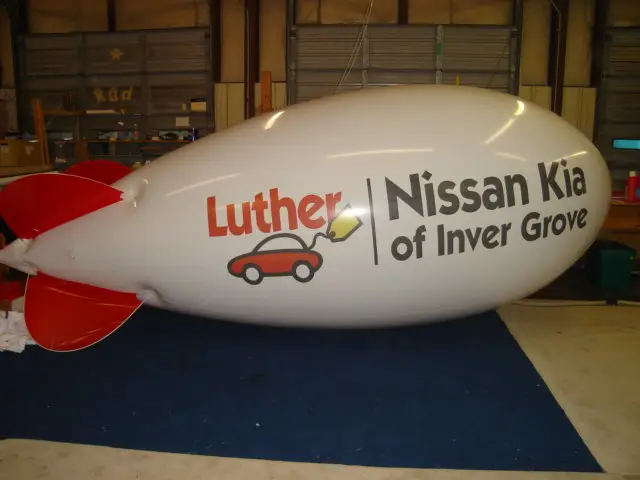
This is where large-format, location-based advertising earns its place back in the marketing mix. Giant helium balloons, inflatable arches, and rooftop-tethered displays create unmissable visual anchors that pull attention from the road, something no search ranking can do. Dealers running seasonal sales events, model-year clearances, or grand openings frequently pair digital campaigns with an advertising blimp flown above the lot to extend visibility for miles, reinforcing the online message with a physical landmark shoppers can navigate toward in real time.
Framed against the AI search gap identified in the Cox Automotive report, this is less a nostalgic tactic and more a hedge. Dealerships betting everything on digital visibility are exposed if their AI optimization lags competitors; dealerships that also invest in commanding, physical local presence protect themselves regardless of how quickly search behavior shifts.
Getting Started at Your Dealership
Marketing teams evaluating their next quarter’s plan should treat this report as a prompt to audit both ends of the funnel — how shoppers find them through AI-powered search, and how shoppers experience the dealership once they are in the area. Low-cost, high-visibility tools like balloons, arches, and blimps typically require no long-term contract and can be deployed around specific sales events, making them an easy complement to ongoing digital investment rather than a replacement for it.
What This Means for Your Marketing
The lesson from this week’s Cox Automotive data isn’t that digital marketing has failed dealerships — it’s that digital alone is no longer sufficient to guarantee visibility. As AI search tools increasingly filter which dealerships even appear in a shopper’s consideration set, the dealerships that also invest in strong local, location-based marketing reduce their dependence on any single channel. Outdoor advertising has a unique advantage here: it works regardless of algorithm changes, platform updates, or how a chatbot ranks results.
For auto dealers, this typically means layering large-format signage, seasonal event promotion, and eye-catching displays on top of digital campaigns rather than choosing one over the other. A shopper who found a dealership through an AI assistant still needs a reason to choose that lot over the next one down the road — and highly visible, well-timed local advertising is one of the most direct ways to give them that reason.
Dealerships looking to diversify their marketing mix beyond digital search can explore helium advertising balloons as a way to build immediate, high-visibility local presence around sales events, grand openings, and model launches — a strategy that complements, rather than competes with, an AI-era digital plan.
Sources
- There’s an AI Gap Between Car Shoppers and Dealerships — Digital Dealer
- New Cox Automotive AI in Auto Retail Tracker Finds Growing Gap Between Dealers and AI-Powered Car Shoppers — Cox Automotive Inc.
- Cox Automotive AI in Auto Retail Tracker Press Release — PR Newswire
- Cox Study Finds 63% of Car Shoppers Plan to Use AI, But Dealers Are Falling Behind — Car Dealership Guy News
Related posts: